

Turnkey processing plant
Red Lentil Cleaning, Dehulling and Splitting Line
One flexible plant for clean bulk lentils, red football lentils and red split lentils—configured around the product, target capacity and required commercial result.
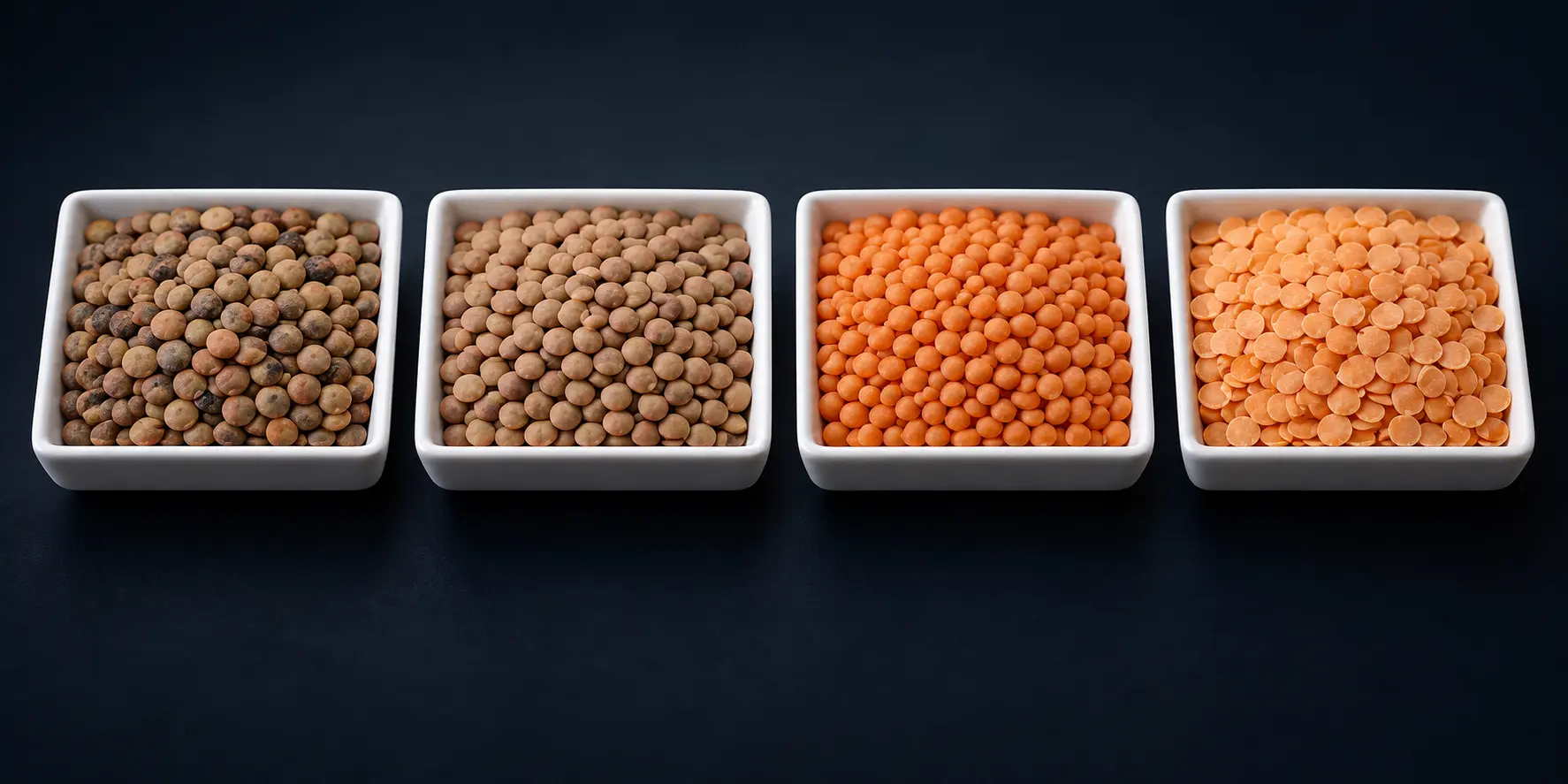
The same plant concept can be configured to process a wide range of pulses according to the raw material and required final product.
Define your capacityRed Lentil Processing Flow Diagram
Select any process card to understand its purpose, input and output. The complete flow shows how one incoming product is directed into clean bulk, football or split lentil production.
- Cleaning and separation. Pre-cleaning and fine screening remove oversize and undersize material. An indented cylinder removes length-based contaminants, followed by destoning and gravity separation. Clean whole lentils can leave here as a bulk product with their seed coats intact.
- Dehulling and grading. The clean feed goes through vertical dehullers. Cleaning and grading separate hulls and broken pieces from whole dehulled lentils and usable halves.
- Football and split routes. Whole dehulled red lentils, known as football lentils, can be finished and sold whole. For split production, the whole dehulled fraction can be dosed with water, tempered and split in horizontal mills. Halves recovered during dehulling can proceed to the split finishing line directly.
- Finishing and bagging. Product cleaning, optical color sorting and final screening prepare the chosen grade for packing. Screen selection, tempering and throughput are confirmed for each project using the raw material and finished-product requirements.
See the pulse cleaning, grading and packaging line for chickpeas, peas, beans and other pulses.
For comparison, see UNIDO’s lentil cleaning, grading and splitting diagrams in File A42 and the Directorate of Pulses Development’s lentil milling diagram in Figure 8.
Frequently asked questions
Planning a lentil processing plant
Clear answers to the questions that most often shape capacity, product routes and project scope.
01How does one line produce three commercial lentil products?
The process can be configured to produce clean bulk lentils, red football lentils or red split lentils. Clean whole lentils can leave after separation. For football and split lentils, the clean feed enters the dehulling section and the outputs are graded for further processing.
02What capacities are available?
Standard plant concepts are available for approximately 5, 10 and 20 tonnes per hour. The final capacity is determined according to the raw material, required product quality and selected process configuration.
03Can the same plant process other pulses?
Yes. The plant can be configured for different pulses such as peas, chickpeas, beans and other lentil varieties. Equipment settings and certain process components may change according to the commodity.
04Can the plant produce both football and split lentils?
Yes. A flexible configuration can support direct football production, direct split production and football-to-split processing within the same plant concept.
05Can clean bulk lentils be produced without dehulling?
Yes. After cleaning and separation, accepted material can leave the process as clean bulk lentils without entering the dehulling and splitting routes.
06Can production routes be changed according to market demand?
Yes. The processing route can be selected according to the commercial product required at that time. Actual switching arrangements depend on the final plant configuration.
07Is the percentage of final product always the same?
No. Product yield depends on the raw material variety, moisture, size distribution, harvest conditions, storage history and the quality specification required for the final product.
08Why is a raw material sample required?
A representative sample helps determine the condition of the incoming product, expected separation behaviour and the most suitable process configuration before the project is finalized.
09What happens to bran, broken pieces and color sorter rejects?
These separated fractions are recovered individually during processing. Bran, broken pieces and selected color sorter rejects are potential feed ingredients, subject to the condition of each fraction and applicable feed requirements.
10Is color sorting included in the process?
Color sorting can be included in the final cleaning route to remove visually defective or off-colour material and improve the consistency of the finished product.
11Is the plant fully automatic?
The level of automation is selected according to the project. The line can include coordinated product routing, automatic gates, process monitoring and centralized control.
12Is every lentil processing plant identical?
No. The processing stages remain consistent, but the final configuration changes according to capacity, raw material, required final products, available building space and customer preferences.
13Can the plant be installed inside an existing building?
Yes, provided that the building dimensions, structural conditions, access points and utility requirements are suitable. The layout is developed specifically for the available site.
14What information is required to prepare a plant proposal?
The main requirements are the raw material, desired final products, target capacity, available building dimensions, electrical standard, installation country and, preferably, a representative product sample.
15What is included in a turnkey lentil processing project?
The scope can include process design, equipment configuration, plant layout, manufacturing, control systems, installation supervision, commissioning and operator training. The exact scope is defined separately for each project.
Value beyond the final product
Separated fractions can remain commercially useful.
Selected fractions recovered during dehulling, calibrating and optical sorting are identified within the process instead of being hidden as an undefined loss.